
The 2030 Market Already Exists on Paper
Synthetic aviation fuels are expected to become a mandatory part of Europe’s aviation fuel supply from 2030 under the ReFuelEU Aviation regulation.
From 2030, sustainable aviation fuel must represent at least 6 percent of aviation fuel supplied at covered EU airports.
For synthetic aviation fuels, the regulation requires a minimum annual share of 0.7 percent in both 2030 and 2031, while suppliers must achieve an average synthetic fuel share of 1.2 percent across the two-year period.
The requirement rises further after 2030, reaching a minimum 5 percent synthetic aviation fuel share from 2035 and 35 percent by 2050.
That regulatory pathway gives developers something that many emerging technologies lack: a defined future market.
The question is whether production capacity can be built quickly enough to supply it.
Current Capacity Is Tiny Compared with Future Demand
The gap between policy targets and physical production remains substantial.
In June 2026, the International Air Transport Association estimated that the combined EU and UK e-SAF requirements for 2030 would require around 0.6 million tonnes of synthetic aviation fuel.
By comparison, global e-SAF production capacity currently operating or under construction was estimated at only around 0.02 million tonnes.
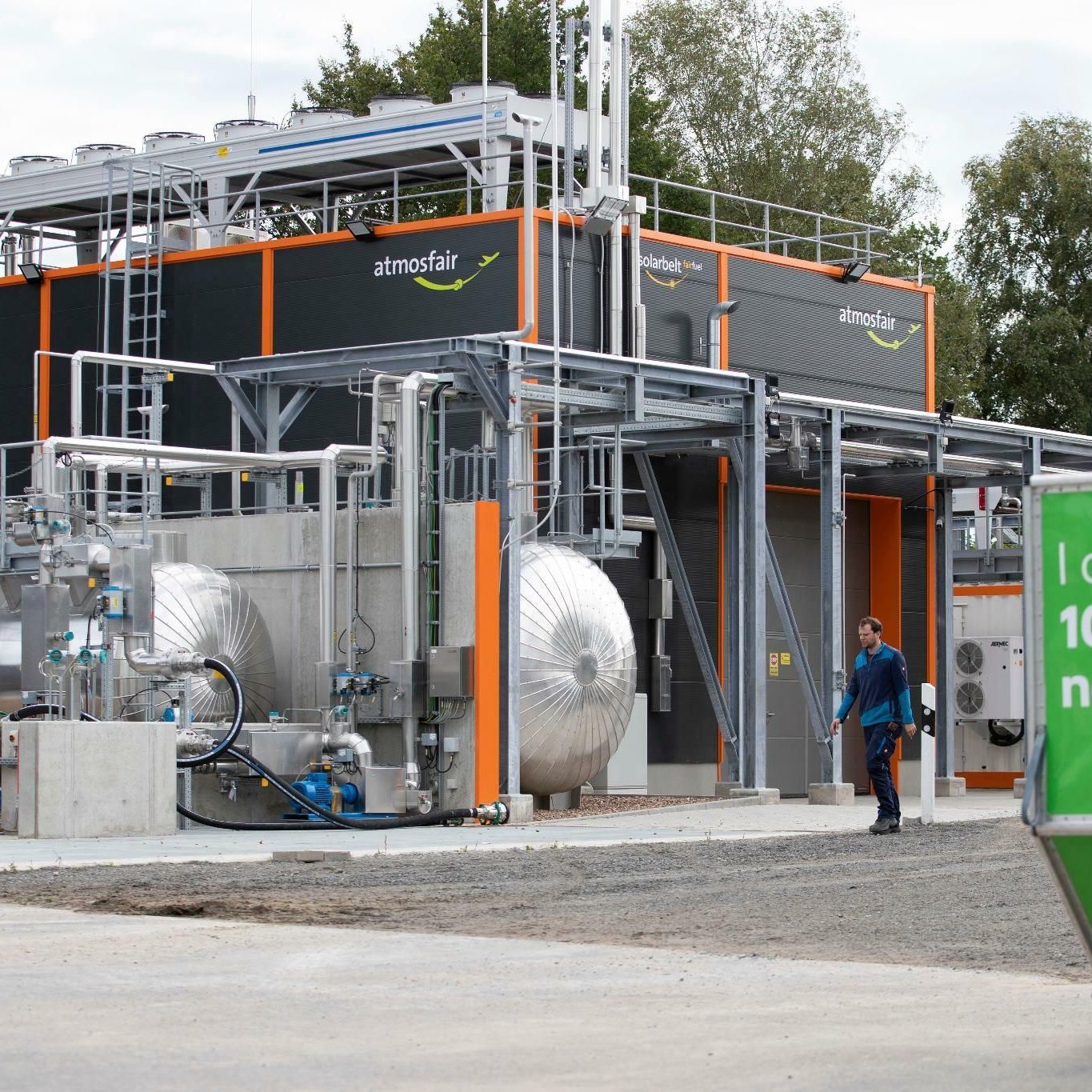
IATA said only one e-SAF production site was operating and estimated that roughly 20 commercial-scale facilities would be needed to supply the mandated 2030 volume.
The European project pipeline is much larger than the amount already being built.
European Commission data indicate that more than 40 e-SAF projects are awaiting Final Investment Decisions.
That distinction is critical. A project announcement does not create fuel. Developers must still secure renewable electricity, hydrogen production, sustainable carbon sources, offtake agreements, financing, permits and construction contracts before commercial output begins.
Renewable Power and Financing May Decide the Outcome
E-fuels avoid many of the feedstock constraints associated with waste-oil-based sustainable aviation fuels, but they create a different set of requirements.
Power-to-Liquids production requires large quantities of renewable electricity to produce green hydrogen, together with water, a sustainable carbon source and additional conversion equipment to manufacture synthetic hydrocarbons.
That makes the availability and cost of renewable electricity central to the economics of e-SAF.
IATA argues that renewable energy supply and e-SAF production capacity need to expand before increasingly demanding mandates can be met at commercially viable prices.
European policymakers take a different view: long-term mandates and investment support are intended to provide precisely the demand certainty developers need before committing billions of euros to new facilities.
The European Commission’s Sustainable Transport Investment Plan estimates that more than €100 billion of investment will be needed by 2035 to scale renewable and low-carbon fuels for aviation and maritime transport.
The EU has also created an eSAF Early Movers Coalition to help accelerate production and uptake.
Whether e-fuels reach meaningful commercial scale before 2030 will therefore depend less on whether the chemistry works — that has already been demonstrated — and more on whether enough projects can secure financing, renewable power and Final Investment Decisions within the next few years.
The decisive metric is no longer the number of announced projects. It is how many move into construction.
Sources
European Union — Regulation (EU) 2023/2405, ReFuelEU Aviation
European Commission — Sustainable Transport Investment Plan
European Commission — eSAF Early Movers Coalition
International Air Transport Association — SAF Production Volumes Still Disappointing, June 6, 2026
European Union Aviation Safety Agency — ReFuelEU Aviation Annual Technical Report